9 B2B Marketing Lessons From 14 Years of Experience
Nine B2B marketing lessons from 14 years of experience, covering organic content, paid advertising, customer acquisition, marketing ROI and authority.


Effective B2B marketing in the automotive aftermarket relies on repeating core messages consistently, documenting real work rather than overproducing corporate campaigns, and tracking lifetime gross profit against acquisition cost. Start organically to prove what resonates, publish ‘how I’ technical content, understand each buyer deeply and deliver genuine value.
I’ve been doing marketing for over 14 years, from starting my own business when I opened a phone shop, all the way through to being head of marketing at an agency and now owning my own marketing agency, Madre.
I’m going to break down nine of the most important marketing lessons I’ve learnt throughout those 14 years, including how we apply them when working with B2B automotive aftermarket brands.
1. Say the same thing in a million different ways
So many times, we have clients who think, Oh, I’ve said that before, or Somebody already knows this.
But most of the time, your audience either hasn’t seen that post, doesn’t remember it or needs reminding.
If you do a specific thing, say that thing in a million different ways. This is going to keep your messaging consistent.
And I promise you, it’s probably only you that’s getting bored.
Your audience has got so much going on that they’re not going to actively remember the thing you said yesterday. But what they will remember over time is that same consistent message you’ve been saying in different ways.
2. Document your business rather than creating content
When it comes to content, a lot of businesses create really corporate content that’s expensive and difficult to produce.
Instead, it’s often better to document what you’re already doing.
For example, if I’m a diagnostic tool supplier and I simply show how I’m working with the tool, that could be much more effective than the £20,000 advert I might get professionally produced.
Perfection isn’t the goal
When we create content, we can put an expectation of perfection on what we need to make. That can sometimes misalign with the content our customers actually want to see.
Typically, they’re going to want to see more hands-on, behind-the-scenes content that actually shows your product or service in action.
Setting up campaigns that you can document, whether that’s through Meta glasses or simply getting us to film you every single month, is going to be much easier than creating a single piece of content that goes out once and kind of dies.
Documenting a process allows you to get a month’s worth of content much more easily.
This is a big part of how we approach content marketing for automotive aftermarket businesses at Madre.
3. Understand your LTV to CAC ratio
LTV is your customer lifetime value, and CAC is your customer acquisition cost.
When it comes to any marketing campaign, we need to establish whether or not a return on investment is being created.
ROI doesn’t mean that we spent £10,000 this month and have to make £20,000 back in the same month.
Instead, look at the lifetime value of your customer, whether that’s over 18 or 24 months, and how much it cost you to acquire them.
Look at lifetime gross profit alongside lifetime value
For example, if I had £10,000 and put it towards marketing and got 10 customers out of it, that means every single customer cost me £1,000 in marketing spend.
What I then need to look at is how much profit we actually make throughout the lifetime of that customer.
There’s a nuance between lifetime revenue and lifetime gross profit.
Personally, I prefer looking at gross profit because revenue alone doesn’t tell us how much money we’re actually making.
If I sell that customer £6,000 worth of products and my gross profit margin is 50%, I’ve made £3,000 in gross profit. After deducting that £1,000 in marketing acquisition costs, I’m left with £2,000 before other costs.
|
Metric |
Example |
|---|---|
|
Marketing investment |
£10,000 |
|
Customers acquired |
10 |
|
Marketing acquisition cost per customer |
£1,000 |
|
Lifetime revenue per customer |
£6,000 |
|
Gross profit margin |
50% |
|
Lifetime gross profit per customer |
£3,000 |
|
Gross profit less marketing acquisition cost |
£2,000 |
When we look at marketing this way, looking at how much money we’re going to make from the customer and how much it cost us to acquire them, there’s less pressure to judge everything on a month-by-month basis.
Instead, we understand how we can scale it.
The two levers you can pull to improve marketing ROI
Once you understand LTV to CAC, you have two levers that you can pull.
The first is reducing your customer acquisition cost.
As your marketing improves month by month, you want your CAC to go down. You should be getting more customers for the same amount of money.
Maybe I get 20 customers from that £10,000. Now they all cost me £500 in marketing spend to acquire.
The second element you need to consider is how to increase your lifetime gross profit.
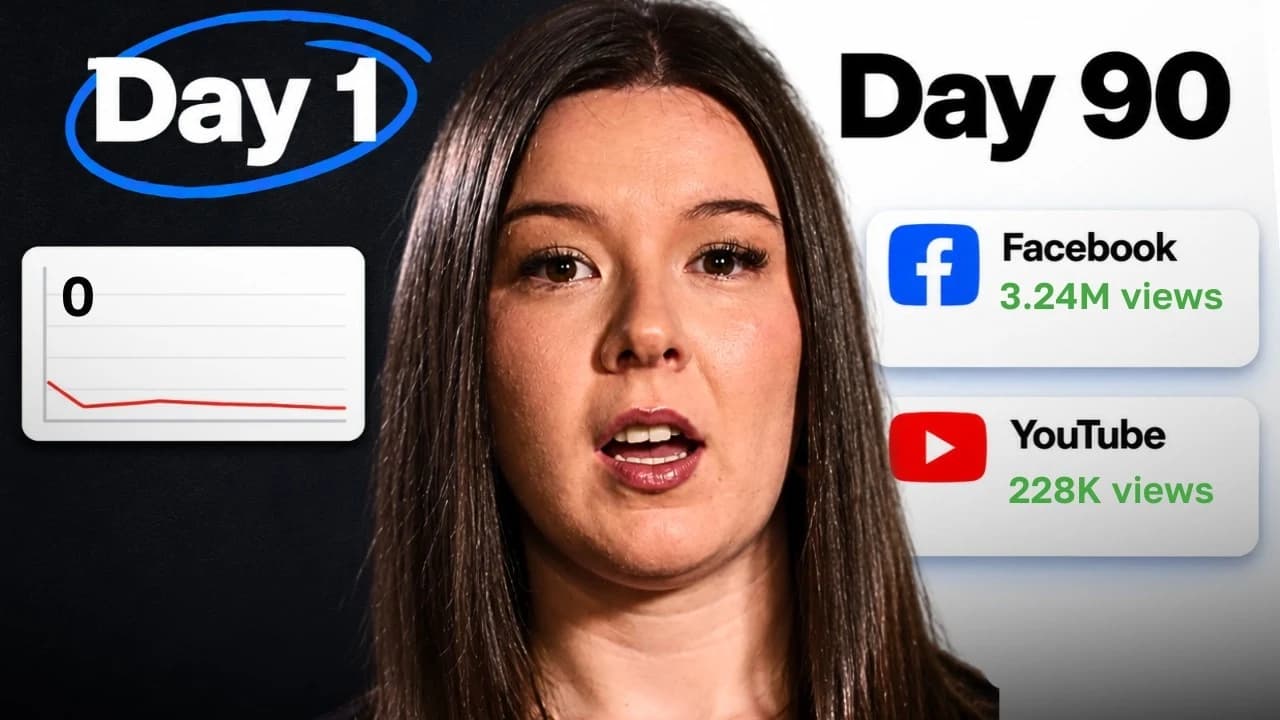
What we’ve learnt over time is that organic content can be particularly effective at increasing lifetime gross profit.
When you use organic social, you have that authority. Customers know, like and trust you, so your initial deal value can go up.
We had a customer whose initial deal value increased threefold within the first six months. For every customer they got in, they were selling them three times the value.
These two levers, when you use them correctly, allow you to look at your marketing from the perspective of:
- How do I get the customer in, and at what cost?
- How do I sell to them on the back end to make sure we’re making money?
With ads, for example, the audience might not already know you unless it’s a retargeting campaign. The initial deal value can be lower, and on the back end, it can be harder to sell because that trust hasn’t been established.
When you have an organic presence, it’s more of a consultative approach.
When I then go into your ecosystem and buy a product from you, I might ask you for advice on the next product or the product I need after that.
Using organic social to increase lifetime gross profit is a big opportunity for any company that wants to start making money online.
4. Digital marketing is one of the most scalable marketing channels
If we look at how people market within the automotive aftermarket, you’ll tend to have publications, exhibitions and digital.
Publications can be expensive for the ROI they produce, and they’re not always as scalable.
I can’t put out five publications every single day and expect somebody to read them.
When it comes to exhibitions, we know that you can spend hundreds of thousands of pounds on a single event. You can’t do that three or four times a day unless you’ve got an enormous amount of resource.
When it comes to digital, that’s completely different.
Scale your reach through organic content
You can post multiple times a day on multiple different channels.
Every single time I put out a post on social media, the platform is going to distribute that content to an audience. When I post a new one, there’s another opportunity to reach more people.
The more good-quality content you put out digitally, the more opportunities you’re creating to get results.
What we’ve seen at Madre is that, in some campaigns, if you want twice the results, posting twice as much has helped us achieve that.
For me, digital is one of the best channels for ROI and one of the easiest to scale.
If you want to understand how I’d put that into practice, I’ve made a full video on the exact social media marketing strategy I’d use for an automotive aftermarket business.
5. Understand when to use paid advertising and organic marketing
Ads and organic marketing work very differently.
When it comes to ads, you’re paying to reach an audience for however long you want to run that advert.
Once you turn it off, that paid distribution stops. You have to consistently pay in order to reach that audience.
With organic, you don’t pay for the distribution itself, but you don’t necessarily get that big boost initially. What you can get over time is that compounding interest.
We’re an organic marketing agency, but that doesn’t mean every problem is a nail and organic marketing is the hammer.
Understanding when to use ads and when to use organic marketing is incredibly important.
When should you use paid advertising?
For example, if I had a product launch, advertising could be the best way to launch it.
It could take ages on social for me to do that launch organically and get enough people around it. With ads, I can send that content out to a relevant audience much more quickly.
As long as I have good creative that I’ve tested on organic, a good landing page and a tight sales process, I can potentially sell more initially through ads.
But a key element of a successful ad campaign nowadays is understanding how your organic marketing works.
There are a lot of businesses that solely go for ads and crank them out 24/7.
We take a different approach.
When you have an organic social media audience and publish a lot of content, and one of those videos hits, you can use that as an ad.
In our experience, we’ve seen that approach perform four to five times better in some campaigns.
Using both organic and paid marketing for different goals and campaigns is really important.
When should you use organic social media marketing?
Organic is going to be valuable if you want to grow an audience that knows, likes and trusts you.
They tune in every single week, they’re commenting, they’re part of your community, and you’ve built a hardcore fan base.
With ads, you don’t automatically get that luxury, but you can tweak and scale campaigns based on the revenue results you want.
What we tend to see with organic, as I’ve mentioned, is that the initial deal value can increase.
But both organic and paid advertising have their place, and both can work.
Equally, think about your own behaviour.
Are you more likely to react to something that’s organic or something that’s an ad?
Typically, when it’s an ad, you might want to skip it unless it’s heavily relevant to you. When you’ve done it right, that’s great.
When it comes to organic, that’s where I would focus if you’re looking to build authority.
6. Create ‘how I’ content
Use ‘how I’ content rather than always creating ‘how to’ content.
Let me explain this, because that statement probably makes barely any sense on its own.
‘How I’ is how I did something.
‘How to’ is something I can ask ChatGPT.
Hey ChatGPT, how do I code XYZ?
Compare that with a YouTube video that says:
Here’s how I’ve just fixed this issue.
When we use ‘how I’ content, it’s more engaging, it has our unique perspective and experience involved, and it builds that authority because people can actually see us solving the problems they’re interested in.
Show your product solving a real problem
Somebody who’s typed in How do I programme XYZ? is interested in solving that problem.
When they see that you’re the people who’ve solved that problem with your product or service, what are they most likely to think?
OK, this is the person who’s actually going to solve that issue for me.
Creating ‘how I’ content in the era of AI makes you stand out because you’re sharing your own experience of solving that problem.
We’ve found that when we create ‘how I’ content rather than ‘how to’ content, we can get up to six times the views.
You can imagine, when you’re creating this problem-and-solution content over and over again and documenting what you do, just how much engagement and how many compounding impressions you’re going to get over time.
When we have more relevant impressions, if we’ve done it well, we should be creating more opportunities to generate revenue.
I’m sure you can see a theme here in what I’ve learnt over the years.
7. Understand your customer persona deeply
If you don’t know who you’re talking to, you’re talking to no one.
I’ve seen this so many times where you’ll look at a post or a video and think, Who is this targeting?
Maybe it’s self-serving. Maybe it’s you who wants to put out this message, but it’s not relevant to your actual audience.
Have you ever been sat down with that friend who only cares about themselves, and they’re talking about themselves over and over again?
You try and get a thing in, like, Yeah, yeah, I’ve done that before.
They don’t care. They carry on talking about themselves.
And it makes you think, Why am I sat having a glass of wine with you? I could be there with my mam, and she loves hearing about my life.
Understanding your customer persona deeply means you’re not that friend who’s just talking about themselves over and over again.
You’re talking about what your customers want, what their ambitions are, what their goals are and how you can help them overcome their challenges.
You can kind of pull them up with you.
I probably should have put this at the top of the list, but there we go.
I’ve made a full video on the six questions you need to answer when building your customer persona.
8. Provide value to your customer
When we’re being that annoying friend who’s only talking about themselves, usually what a business will do is say:
I’ve got KPIs and I have to sell a thousand of these units, so I’m just going to spam social with specs, AI graphics and pictures of this product.
What you’re not doing is understanding the transformation your customer needs to go through when it comes to your product or service.
Market the outcome your customer is purchasing
I don’t care if your diagnostic tool has the best LCD, LED or OLED screen ever.
What I care about is when a Nissan comes in with a security gateway, can I charge for that job because I can do the work in-house?
I need to understand the outcome, and I need you to show me how I can actually do it.
I don’t want you to just tell me you’ve done it.
All of these lessons connect. You’re providing value because you understand the customer. You’re doing it organically to grow that audience, and you’re using ‘how I’ content to demonstrate the value you can provide.
9. Everything works if you’re good at it
If you’re incredible at marketing through publications, it can work.
When it comes to running ads, that can work too.
If you’re good at a specific marketing channel, it can work for you. You just have to be good at it.
This is what’s important when it comes to social media because, as I’ve mentioned, I consider it one of the most scalable marketing channels with enormous potential for ROI.
But if you’re not good at it, it’s not going to work well for you.
In the same way that with an editorial, you might want to think about what’s above the fold, how you talk to the customer and where to put that CTA, it’s the same on social.
You need to think about the hook. You need to think about how you draw people in. You need to think about what’s working and what’s native to the actual platforms.
A bonus lesson: Social media isn’t respected enough
If I could put a number 10 on this list, it would be that social media isn’t respected enough.
It’s seen as, Oh, kids use it. Oh, people dance on it.
But people have become millionaires through social media. Businesses have generated billions of pounds through organic content.
If you’re not taking it seriously enough, you’re probably not taking the time to get good at it.
You’re just putting things out and wondering why you’re not making any money from it.
Being good at social media is one of the biggest assets you can have as a business.
Frequently asked questions
Why should B2B suppliers measure gross profit instead of revenue in LTV to CAC?
Revenue alone doesn’t account for the cost of supplying products and delivering services. As an illustrative example, a customer generating £6,000 in lifetime revenue at a 50% gross margin gives you £3,000 in lifetime gross profit. Deduct a £1,000 customer acquisition cost and you’re left with £2,000 before other business costs.
Should B2B aftermarket brands start with organic social media or paid ads?
Start with organic content to test your messaging, build trust and reach potential customers who aren’t actively looking to buy yet. Once you’ve identified which content and landing pages consistently generate enquiries, you can put advertising spend behind them. This gives you a better understanding of what you’re paying to promote.
What is ‘how I’ content and why does it work for aftermarket suppliers?
‘How I’ content shows a technician or specialist using your product to solve a real workshop problem. It builds technical authority and helps buyers understand the commercial benefit. For example, demonstrating a job involving a Nissan security gateway helps a garage owner assess whether they could complete and charge for that work in-house.
Putting these B2B marketing lessons into practice
I understand that not every business can get 14 years of social media marketing experience in a single training course.
And that’s exactly why, at Madre, you can hire us to do it for you.
We’ve generated millions of pounds in revenue and millions of views through social media content for automotive aftermarket brands.
If you’re an aftermarket business in the B2B space, selling to garages, distributors or motor factors, and you’re tired of knowing that social media can work for you but never seeing the results, book a free audit with us.
You can also learn more about our social media marketing services for the automotive aftermarket.
If you want to understand how this marketing expertise drills down into a specific plan so you can get going and test the waters, I’ve made a full video on how to create a social media marketing plan, with a free workbook so you can follow along.

Work with Madre
Where could your digital marketing work harder?
Book your free V8 Digital Audit and we will show you where your social, search, site and sales can work harder for your aftermarket brand.
Book your free V8 Digital Audit