Is SEO Dead? How AI Is Changing Search and Marketing
Is SEO dead because of AI? Explore what the search data really shows and how automotive aftermarket brands can connect SEO, video and social media.

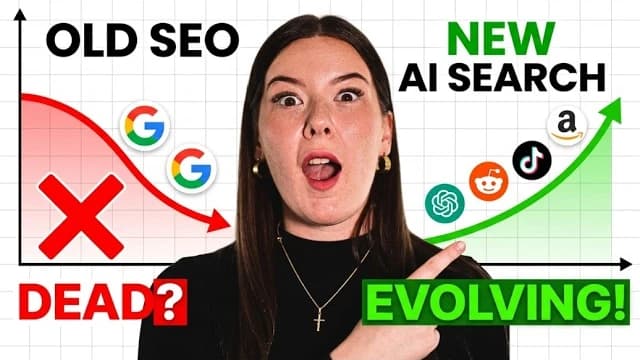
No, SEO isn’t dead, but search now happens across Google, YouTube, AI tools, Amazon and social platforms. Aftermarket brands should build content around commercially relevant keywords, add their own expert perspective, use long-form video to fuel their social media and keep improving their website so it converts the demand they create.
SEO is dead and AI killed it. ChatGPT is slaying Google and now nobody clicks a single link.
You may have heard a version of this story being told, and some of it does hold a bit of truth. AI Overviews are answering questions directly within Google, and people are also searching on platforms like ChatGPT, Claude, TikTok, Amazon, Reddit and YouTube.
But when you look into the search data, you actually see a different story.
We’re going to dig into what’s happening across search, whether SEO is dead and exactly how you can adapt your marketing strategy as an automotive aftermarket business.
Is SEO dead? What the search data actually tells us
Firstly, Google is still absolutely massive.
In a study by SparkToro and Datos covering 41 websites with significant search activity, around 80% of US desktop searches were still taking place on traditional search engines. Google alone accounted for 73.7% of the searches measured in the final quarter of 2025.
To put that into perspective, AI tools accounted for just 3.2% of the desktop search activity measured in that same US analysis.
So, the idea that everybody has stopped Googling and is suddenly using ChatGPT for everything is blown way out of proportion. It isn’t supported by this data.
Search is fragmenting across different platforms
Although Google is still a Goliath of search, we are seeing more platforms chipping away at its share.
Google lost 3.5 percentage points of US desktop search share over the course of 2025 within the study. That might sound like it’s not a lot, but in terms of the scale of search and what Google is, it’s something we do need to track and pay attention to.
The more interesting bit when it comes to our AI narrative is that Amazon, Bing and YouTube all gained share, but ChatGPT actually lost a little share over that period. This is about their relative share of the measured searches, rather than their total search volumes.
What we’re seeing here is that search isn’t going away. It’s fragmenting into many different platforms.
So, what can we as B2B marketers take away from this and implement into our marketing strategy? As the market share chips away from Google, how do we make sure we’re in a place where that growth can accelerate our brand, our revenue and our reputation within search?
The good news is that we have an opportunity to get in early.
How AI search, YouTube and social media work together
The first thing we need to understand is that a lot of this fragmentation is weighted in certain ways, and there’s a lot of overlap.
Take YouTube and social media, for example.
Social media content can now be cited inside Google’s AI Overviews. A post you put out could become one of the sources referenced when somebody searches for a topic relevant to your business.
On top of that, YouTube is a prominent citation source in AI Overviews, as Pew Research Center’s analysis found. It’s also a massive search platform in its own right.
There’s a lot we can do here to essentially set up a domino effect. We’re creating opportunities to be cited in AI, to be found on social media and to be searched for on YouTube. Equally, we’re building our brand authority and creating content assets that can continue to generate visibility over time.
At Madre, we’ve used our marketing approach to generate over £25 million in revenue for our clients. That’s the important part when it comes to search: making sure we’re generating revenue and allocating our resources to the correct place.
Let’s take a look at exactly how we would set that up.
1. Use keyword research to choose your content topics
The first thing we need to do is look at our content topics.
If you don’t get this right, there’s very little point in going any further, because the content topics are the gateway into search.
If this is a search-specific strategy, we need to make sure we’re doing the correct keyword research.
We now have much more of an interest-based algorithm on social media. People’s interests and online behaviour help determine what content they’re shown in their feeds.
Making sure our strategy has focused keyword targets and commercially relevant content gives us a much better opportunity to be found through search, AI citations and social media recommendations.
So, if you’re using motorsport content because it’s sexier than a brake disc, I’d rethink that. You need to focus on your products, your services and the revenue-generating content that your actual customers are interested in.
How to find commercially relevant keywords
Our keyword research typically involves a tool such as Semrush or Ahrefs. But there is a way you can do some of it for free.
Type in your target keywords and check what Google suggests. Look at the other questions and searches that appear around your topic. This will help you get an idea of what people are searching for within your niche.
The issue you have is that you won’t have the estimated search volume or keyword difficulty from those suggestions alone, and that might lead you astray.
I would recommend investing in a good keyword research tool if this is going to be a big part of your strategy.
2. Run a brain extraction session to get your unique perspective
Once we have our topics, the next thing we’re going to do is what’s called a brain extraction.
At Madre, we found it really important that we weren’t just going to ChatGPT or Google to research the topics we wanted to talk about, because a lot of that information can already be generated in a single prompt.
So, what’s the point of watching your video?
For example, if you could Google everything you were going to get from this article, what would be the point in reading it? Instead, I’m giving you a perspective of how we do things.
That’s exactly the type of content your customers are going to want to watch.
How to run a brain extraction session
The first thing you’re going to want to do is get your founder, leadership team or sales team into a room.
Get them for an hour. They’ll probably talk for longer, but what you’re going to do is ask them a series of selective questions around the content topics you’ve already researched.
This could be about questions your customers ask, a certain keyword or a product line you’re currently launching.
What you’re going to get is a unique perspective that you can’t simply Google or find through ChatGPT.
The things I always watch out for in a brain extraction session are:
- A customer story.
- An experience the salesperson or founder has had.
- The story of why we’re selling this product in the first place.
All of these allow you to tell the story of a pain point the customer already has that you’ve helped solve. That’s going to make your content much more useful and relevant to the people searching for it.
A lot of the content aftermarket brands are putting out at the moment just isn’t engaging enough. Why would somebody want to consume a graphic full of specs and benefits when they could watch somebody actually solve their problem?
This is why we use brain extraction sessions as part of our content marketing strategy at Madre.
3. Create long-form videos around your keyword research
Our strategy is very video-led, so the next thing you’re going to want to do is write your script.
When it comes to your script, you’re going to need a hook so people are drawn into the video. Then lay out the sections so it’s very obvious to the viewer what they’re going to learn next.
Without that, it can get a bit muddy and you’re going to lose retention.
Make your video scripts sound natural
When it comes to your video, write out a purposeful script.
Please, for the love of God, don’t just get ChatGPT to write the script for you and then read it out. When it’s said out loud, it can sound like ChatGPT, which isn’t going to help your engagement.
If I could give you any tip on how to produce a good video, just be talking to the camera.
If you have an expert in-house, typically you can give them a bit of a prompt. If they’re not completely intimidated by the camera, they’ll be able to come across quite naturally.
At the end of your video, put a simple CTA that takes them to the next relevant video, so views across the channel can compound over time. This allows them to stay within your ecosystem and eventually gives them an opportunity to get onto your website.
If you want to understand how we approach thumbnails, scripting and video optimisation, I’ve created a full guide to getting more views on YouTube.
Why long-form video matters for search and AI visibility
When you’re creating video content, you have the opportunity to be found through the massive search platform that is YouTube.
People, especially mechanics, are putting in queries for problems they’re having, struggles they’re coming up against and real-life situations they want the answer to.
If your brand is there to help them with that solution, can you imagine the brand affinity you’re going to get in exchange?
On top of that, as I mentioned, YouTube can also be cited when it comes to AI search. When you have a Google AI Overview, you’ll sometimes notice YouTube videos appearing among the sources.
This means we can talk about broader topics that a blog post or a website might cover, and also do it through an engaging video where people can see the product or service in action.
Equally, let’s not underestimate what video does. If I talk to you through a blog, you’re probably not going to feel like you know me as much as if you’ve spent 10 minutes watching one of my videos.
This is a big part of why we focus on automotive video marketing.
4. Use your long-form videos to create a wider social media campaign
The next consideration when it comes to video is how it’s going to fill the rest of your content pipeline.
Inside one long-form video, you have sections, and each of those sections has its own isolated topic.
Let’s say, for example, you have seven sections in one video. That’s potentially seven posts you can generate from that single video, because each topic could be explained through an individual static post.
You’re not going to explain the full video in one single post.
That gives you a week’s worth of content ideas from one weekly video.
Think about it. We’ve already done the keyword research for this specific video. Now we’re putting that research and dedication into our static posts without having to repeat the entire process over again.
This is how you’re going to create social media content over the long term that’s aligned with the search fragmentation we’re seeing now.
I’ve also created a video explaining how we use distribution posts to increase YouTube views, if you want to see how we promote those videos.
Create a month’s worth of content from one filming day
The best bit about this is that you don’t need to be in front of the camera every single day to make it happen.
At Madre, we aim to film everything within one day and create a month’s worth of content around that, as well as handling the scripting, editing and promotion of the video content.
This is the approach we use to build our clients’ presence across social media and search.
It’s important not to just dabble in this, because you can put a lot of resource into it and get it wrong.
If you’re an automotive aftermarket business and you’d like us to help with your social media marketing, you can book a free audit and we’ll chat through whether we’re a good fit.
5. Keep investing in traditional SEO and website conversions
We can get everything right, from the videos to the social posts, and be cited in AI search. That’s great. It means more people have an opportunity to see our brand.
But we still need to turn that visibility into revenue. For many businesses, that’s where the website comes in.
Traditional SEO is still vital to making sure we show up in search engines, because websites are also cited in AI-generated answers.
Even Google’s own guidance on AI features explains that the fundamentals of SEO still apply.
Focus your website SEO on commercial keywords
When it comes to your website, I’d be looking at the keywords where we have gaps commercially, how many clicks we’re generating and how much revenue we’re generating from those clicks, where we can measure it.
Once we have that information, we can focus on our commercial keywords and optimise the website around them.
This might all sound like jargon, and when it comes to SEO, you may want to get a professional to help you do it properly.
For an aftermarket business, dedicating resource to automotive SEO around commercially relevant topics can be a really valuable long-term investment.
What do zero-click searches mean for your website?
We also have the issue of how we generate revenue from search when so many searches don’t end with a click.
In SparkToro and Datos’ 2024 zero-click search study, 59.7% of Google searches in the EU and 58.5% in the US ended without a click.
Pew Research Center’s 2025 analysis also found that Google users were less likely to click on search results when an AI summary appeared.
This is why that keyword research and making sure we have visibility across a range of commercially relevant queries is important. You’re spreading the load rather than relying on a handful of searches.
But when people do get onto your website, we need to make sure we’re converting them.
That’s the next stage in how we generate revenue through this plan. I’ve created a full video explaining why your website isn’t converting and how to improve it.
Frequently asked questions
Is AI replacing Google search?
Not according to the data we looked at. SparkToro and Datos found Google handled 73.7% of US desktop searches across the 41 sites they analysed in Q4 2025, while AI tools combined made up 3.2%. AI is changing how results look, so you still need to show up wherever your buyers search.
What is a brain extraction session?
It’s a call where we ask your experts the questions we found through keyword research. What they say gives us the unique perspective, stories and technical knowledge that generic AI content can’t copy. We then build that into the scripts for your long-form videos and the social media content that comes from them.
What do zero-click searches mean for aftermarket websites?
Many searches now end without a click. SparkToro and Datos’ 2024 study found 58.5% of US and 59.7% of EU Google searches ended that way. That makes every click you earn more valuable, so focus your website SEO on commercial keywords and make it easy for buyers to convert.
So, is SEO dead?
No. Search is fragmenting across more platforms, and we need to make sure we’re in the places our customers are already searching.
We need to create content around commercially relevant keywords, get our unique perspective into that content, use long-form video to fuel the rest of our marketing and make sure our website can convert the demand we’re generating.
If you want to go deeper into AI search specifically, I’ve created a guide to five AI search optimisation strategies for automotive aftermarket brands.

Work with Madre
Where could your digital marketing work harder?
Book your free V8 Digital Audit and we will show you where your social, search, site and sales can work harder for your aftermarket brand.
Book your free V8 Digital Audit